The thermochemical database and companion thermophysical database are current initiatives under the DOE Molten Salt Reactor Program and the Nuclear Energy Modeling and Simulation Program.
Virtual MSTDB-TC workshop is being hosted by USC and ORNL on June 3, 2025-June 4, 2025
The workshop will be focused on the effect of oxygen, hydrogen, and moisture on molten salt behavior. The agenda and meeting link can be found here, no registration is necessary!
About the MSTDB-TC
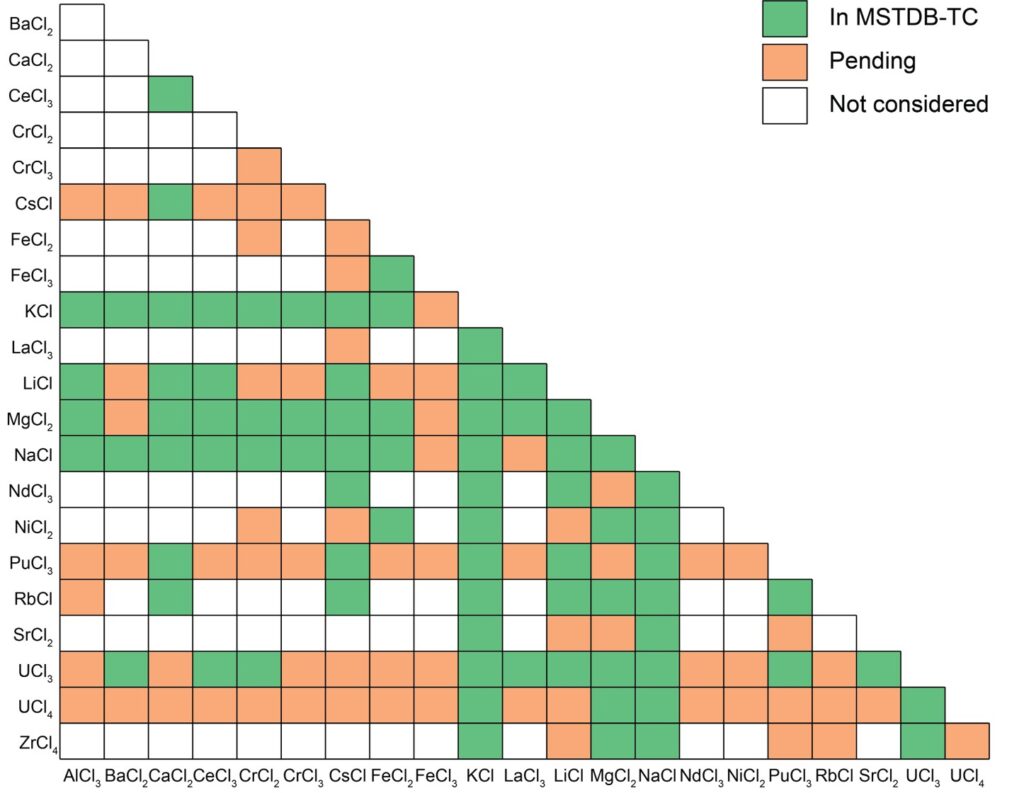
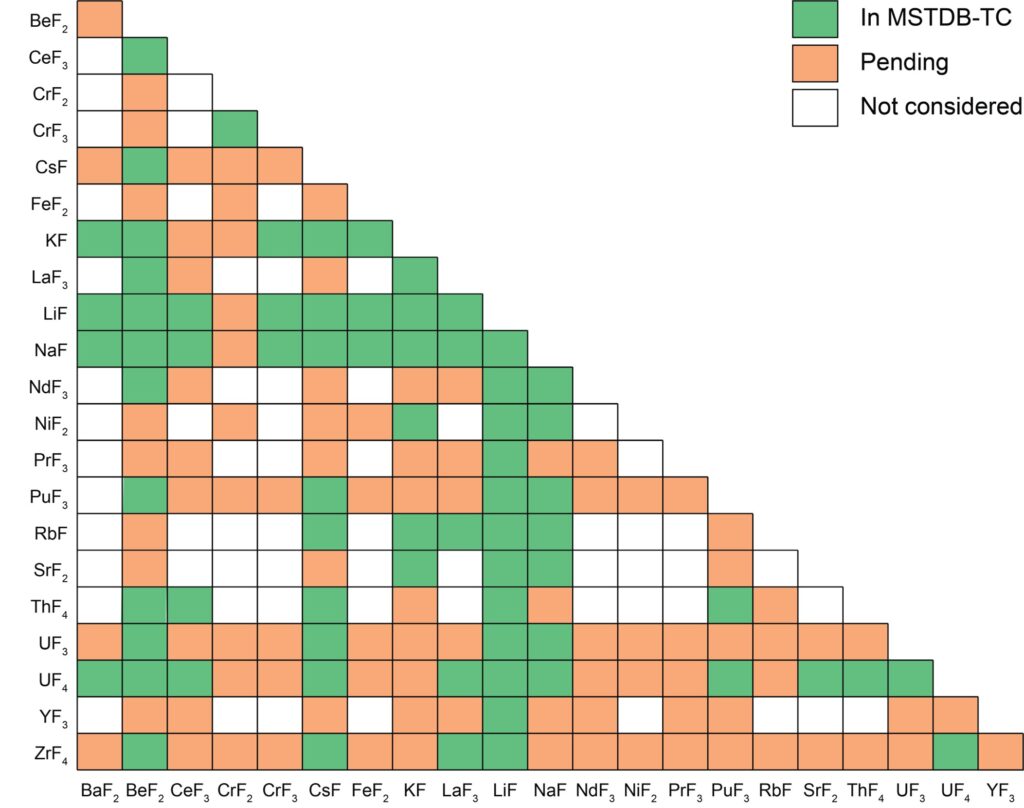
The recent re-emerging interest in MSRs following the Molten Salt Reactor Experiment at ORNL over 50 years ago, has generated DOE efforts focused on supporting the several commercial MSR ventures. This includes the development of the Molten Salt Thermal Properties Database-Thermochemical (MSTDB-TC) and a companion thermophysical database, MSTDB-TP. MSTDB-TC is a publicly available compendium of internally consistent thermodynamic models and values for fluoride and chloride molten salts components and related systems of interest to MSR technology.
- MSTDB-TC thermodynamic information resides in “Chemsage” .dat (ASC II) format files for use with the FactSage® commercial thermodynamic codes and with the open-source equilibrium code Thermochimica.
- Separate files are provided for chloride- and for fluoride-based systems.
- Documentation includes
- Detailed description of the current database format and current version
- Spreadsheet tracing all data sources
- Library of published phase diagrams together with companion MSTDB-TC-computed phase diagrams for direct comparison
Accessing the Databases
The databases and associated documents are hosted on a publicly accessible, permission-protected server at Oak Ridge National Laboratory (ORNL). Access requires an ORNL XCAMS account and an MSTDB membership, which once granted will allow downloading of all files. Instructions for obtaining the databases are at MSTDB Access Instructions.
MSTDB-TC Reference Documents/Publications
- Development of the Molten Salt Thermal Properties Database − Thermochemical (MSTDB−TC), example applications, and LiCl−RbCl and UF3−UF4 system assessments
- Developing Practical Models of Complex Salts for Molten Salt Reactors
- Molten Salt Thermodynamic Database-Thermochemical (MSTDB-TC)
- Thermodynamic assessment of lithium halide reciprocal salt systems for energy applications
MSTDB-TC Version 4.0 has been released!
Version 4.0 contains:
- 175 pseudo-binary systems
- 61 pseudo-ternary systems
- 12 reciprocal systems that include iodine as anion
- New models that consider ZrCl4, BaCl2, SrCl2, BaF2, SrF2, LaCl3
- Refined NaCl-MgCl2 based on new experimental data
- Refined reciprocal systems with iodine